
Introduction
In the world of research peptides, purity is not just a selling point — it is the foundation of reproducible, meaningful scientific results. High-Performance Liquid Chromatography (HPLC) remains the gold standard for peptide purity analysis, and understanding what these results mean is essential for any researcher selecting their materials.
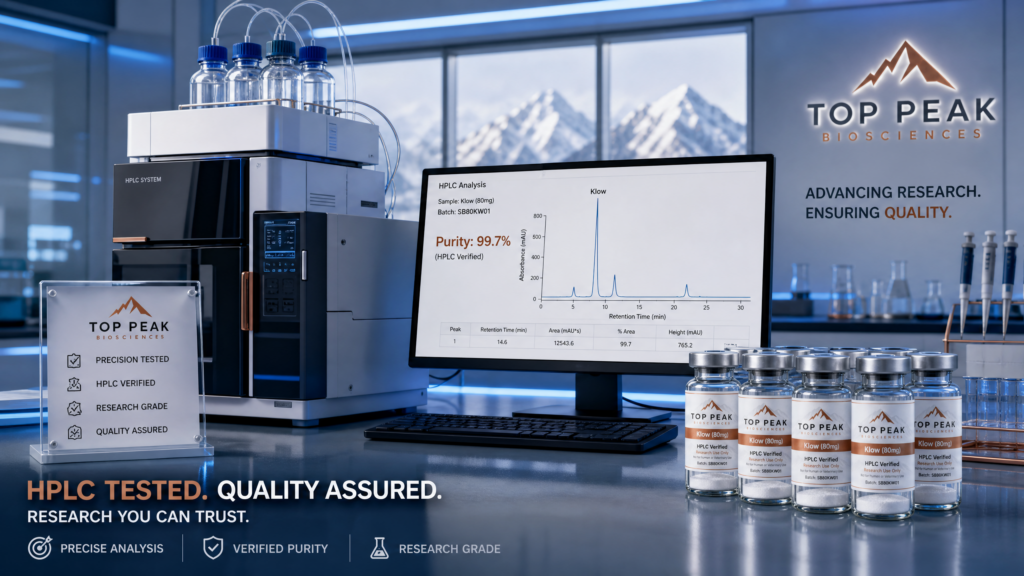
At TOP PEAK BIOSCIENCES, every product carries the “HPLC Verified” designation because we believe transparency in quality is non-negotiable. This article explains what HPLC testing involves, how to read a Certificate of Analysis (COA), and why it matters for your research outcomes.
What is HPLC?
High-Performance Liquid Chromatography is an analytical technique that separates, identifies, and quantifies components in a mixture. For peptide analysis, it works by:
1.Dissolving the peptide sample in a mobile phase (solvent)
2.Pumping the solution through a column packed with stationary phase material at high pressure
3.Separating components based on their chemical interactions with the column
4.Detecting each component as it elutes, typically using UV absorption at 214nm or 220nm
5.Quantifying purity based on the area under each peak in the resulting chromatogram
Types of HPLC Used in Peptide Analysis
| Method | Application | Detection |
| Reversed-Phase HPLC (RP-HPLC) | Primary purity assessment | UV at 214/220nm |
| Size Exclusion HPLC (SE-HPLC) | Aggregation analysis | UV at 280nm |
| Ion Exchange HPLC (IEX) | Charge variant analysis | UV at 214nm |
| UPLC (Ultra Performance) | High-resolution separation | UV/MS |
For research peptides, Reversed-Phase HPLC is the standard method, as it provides excellent separation of the target peptide from synthesis-related impurities such as:
•Deletion sequences (missing one or more amino acids)
•Truncated sequences
•Oxidized forms
•Deamidation products
•Residual protecting groups
Reading a Certificate of Analysis
A comprehensive COA from a reputable supplier should include:
Essential Information
•Product Name and Catalog Number
•Batch/Lot Number — Unique identifier for traceability
•Molecular Weight — Confirmed by mass spectrometry
•Purity (%) — Determined by HPLC, typically reported as area percentage
•Appearance — Physical description of the lyophilized product
•Sequence — Amino acid sequence confirmation
Quality Metrics
•HPLC Chromatogram — Visual representation of the separation
•Retention Time — When the main peak elutes (confirms identity)
•Peak Area % — Quantitative purity measurement
•Mass Spectrum — Molecular weight confirmation (MS or LC-MS)
•Water Content — Karl Fischer titration result
•Peptide Content — Net peptide weight (accounting for counter-ions, water, salts)
Why Purity Matters: The Research Impact
Reproducibility
Impure peptides introduce unknown variables into experiments. A peptide listed at 95% purity contains 5% of uncharacterized material that could:
•Produce off-target effects in cell-based assays
•Alter binding kinetics in receptor studies
•Confound dose-response relationships
•Lead to irreproducible results between batches
Dose Accuracy
If a researcher weighs 10mg of a peptide with 90% purity, they are actually working with only 9mg of active compound. This 10% discrepancy compounds across dilution series and can significantly impact:
•IC50/EC50 determinations
•Pharmacokinetic calculations
•Structure-activity relationship studies
Publication Standards
Leading journals increasingly require detailed characterization data for all research materials. Having comprehensive COA documentation supports:
•Peer review transparency
•Method reproducibility by other groups
•Regulatory submission requirements
TOP PEAK BIOSCIENCES Quality Standards
Our commitment to quality goes beyond basic HPLC testing:
Multi-Method Verification
| Test | Purpose | Acceptance Criteria |
| RP-HPLC | Purity | ≥98% (most products ≥99%) |
| LC-MS | Identity confirmation | MW within ±1 Da |
| Endotoxin (LAL) | Sterility | <1 EU/mg |
| Water Content | Stability | <8% |
| Appearance | Physical QC | White to off-white powder |
Batch Traceability
Every vial from TOP PEAK BIOSCIENCES carries a unique batch number (e.g., PPK10BP01) that links to:
•Complete analytical records
•Raw material sourcing documentation
•Manufacturing date and conditions
•Stability data
COA Accessibility
All Certificates of Analysis are available through our COA Library on the website, searchable by product name or batch number. We believe researchers should have immediate access to quality data without barriers.
Red Flags: What to Watch For
When evaluating peptide suppliers, be cautious of:
1.No COA available — Reputable suppliers always provide batch-specific documentation
2.Generic COAs — Documents that don’t reference a specific batch number
3.Purity claims without chromatograms — The raw data should be visible
4.Inconsistent molecular weights — MS data should match the theoretical MW
5.No batch numbers on vials — Traceability is fundamental to quality systems
Conclusion
HPLC verification is not merely a quality checkbox — it is the researcher’s assurance that their materials meet the standards necessary for meaningful scientific work. At TOP PEAK BIOSCIENCES, our “HPLC Verified” designation represents our commitment to providing research-grade peptides that you can trust for reproducible, publication-quality results.
Every vial we ship carries a batch number linked to comprehensive analytical data, because we believe the integrity of your research starts with the integrity of your materials.
This article is for informational and educational purposes only. All products are sold strictly for research use. Not for human or veterinary use.
Questions about our quality processes? Contact support@toppeakbio.com