
Introduction
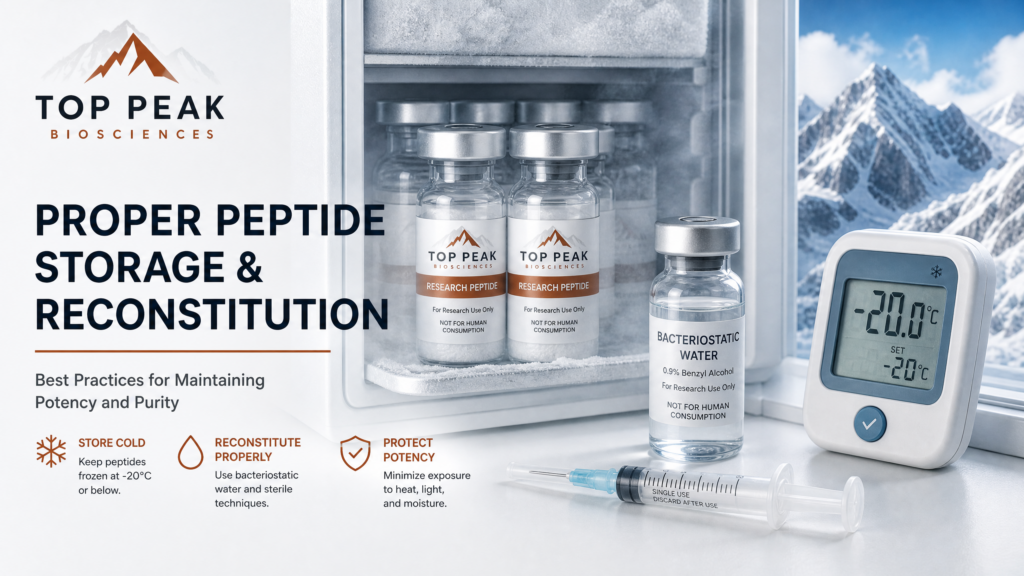
Proper storage and reconstitution of research peptides is critical for maintaining compound integrity and ensuring experimental reproducibility. Even the highest-purity peptide will degrade rapidly if handled incorrectly, leading to wasted materials and compromised research outcomes.
This guide covers everything researchers need to know about receiving, storing, reconstituting, and handling lyophilized peptides from TOP PEAK BIOSCIENCES.
Understanding Lyophilization
All TOP PEAK BIOSCIENCES peptides are supplied as lyophilized (freeze-dried) powders. This process removes water from the peptide solution under vacuum at low temperature, resulting in a stable, dry cake or powder that offers:
•Extended shelf life — Up to 24 months at -20°C
•Reduced degradation — Minimizes hydrolysis, oxidation, and aggregation
•Ease of transport — Stable at ambient temperature for short shipping periods
•Flexible reconstitution — Researcher controls final concentration
Storage Guidelines
Lyophilized (Unreconstituted) Peptides
| Condition | Temperature | Expected Stability |
| Long-term storage | -20°C to -80°C | 18-24 months |
| Short-term storage | 2-8°C (refrigerator) | 3-6 months |
| Ambient (shipping) | 15-25°C | 2-4 weeks |
| Avoid | >30°C, direct sunlight | Rapid degradation |
Key Storage Principles
1.Keep sealed until use — The original crimped vial provides an inert atmosphere
2.Minimize light exposure — UV radiation accelerates peptide degradation
3.Avoid humidity — Lyophilized peptides are hygroscopic; moisture initiates degradation
4.Do not repeatedly freeze-thaw — Each cycle risks structural damage
5.Store upright — Prevents powder from contacting the stopper
Upon Receiving Your Order
When your TOP PEAK BIOSCIENCES package arrives:
1.Inspect the vial for any damage or signs of reconstitution (powder should be dry)
2.Check the batch number matches your order confirmation
3.Transfer immediately to appropriate storage temperature
4.Record the receipt date for your lab inventory system
5.Download and file the COA from our website
Reconstitution Protocol
Materials Needed
•Lyophilized peptide vial (TOP PEAK BIOSCIENCES)
•Bacteriostatic water (BAC water) or sterile water
•Alcohol swabs (70% isopropanol)
•Sterile syringe with needle (insulin syringe recommended)
•Calculator (for concentration determination)
Choosing Your Solvent
| Solvent | Use Case | Shelf Life After Reconstitution |
| Bacteriostatic Water | Multi-use over days/weeks | Up to 28 days at 2-8°C |
| Sterile Water | Single-use applications | Use within 24 hours |
| Acetic Acid (0.1%) | Hydrophobic peptides | Up to 14 days at 2-8°C |
| DMSO | Very hydrophobic peptides | Up to 30 days at -20°C |
Recommendation: For most TOP PEAK BIOSCIENCES peptides, bacteriostatic water is the preferred reconstitution solvent. We offer BAC water in both 3mL and 10mL vials for convenience.
Step-by-Step Reconstitution
Step 1: Preparation
•Allow the peptide vial to reach room temperature (5-10 minutes)
•Clean your workspace and gather all materials
•Swab the vial stopper with an alcohol wipe
Step 2: Calculate Volume
Determine the reconstitution volume based on your desired concentration:
Plain Text
Volume (mL) = Peptide Amount (mg) ÷ Desired Concentration (mg/mL)
Example: 10mg BPC-157 at 5mg/mL concentration:
Plain Text
10mg ÷ 5mg/mL = 2mL bacteriostatic water
Step 3: Add Solvent
•Draw the calculated volume of BAC water into a sterile syringe
•Insert the needle through the vial stopper at an angle
•Slowly dispense the water down the inside wall of the vial
•Do NOT inject directly onto the powder cake — this can damage the peptide
Step 4: Dissolve
•Allow the water to gently flow over the lyophilized powder
•Do NOT shake or vortex — this can cause aggregation and denaturation
•Gently swirl the vial if needed, or let it sit for 2-3 minutes
•The solution should become clear and colorless
Step 5: Verify
•Inspect the solution for clarity — it should be free of particles
•If cloudiness persists, allow more time at room temperature
•A slightly opalescent solution may indicate aggregation — do not use
Step 6: Store
•Return the reconstituted vial to 2-8°C (refrigerator)
•Label with: reconstitution date, concentration, and solvent used
•Use within the timeframe appropriate for your solvent choice
Common Reconstitution Volumes
| Product | Amount | Suggested Volume | Resulting Concentration |
| BPC-157 | 10mg | 2mL | 5mg/mL (5000mcg/mL) |
| Tirzepatide | 10mg | 2mL | 5mg/mL |
| Retatrutide | 15mg | 3mL | 5mg/mL |
| NAD+ | 500mg | 5mL | 100mg/mL |
| Semaglutide | 20mg | 2mL | 10mg/mL |
| MOTS-C | 20mg | 2mL | 10mg/mL |
| Selank | 10mg | 2mL | 5mg/mL |
| GHK-Cu | 100mg | 5mL | 20mg/mL |
Troubleshooting
Peptide Won’t Dissolve
•Allow more time (some peptides take 5-10 minutes)
•Gently roll the vial between your palms
•Try adding a small amount of acetic acid (0.1%) for hydrophobic peptides
•Do NOT sonicate or heat
Solution is Cloudy
•May indicate aggregation — allow to sit at room temperature for 30 minutes
•If cloudiness persists, the peptide may have been compromised
•Check storage history for temperature excursions
Powder Appears Wet or Discolored
•May indicate moisture ingress or degradation
•Do not use — contact TOP PEAK BIOSCIENCES for replacement
•Check that storage conditions were maintained
Stability After Reconstitution
Factors That Accelerate Degradation
1.Temperature — Every 10°C increase roughly doubles degradation rate
2.pH — Most peptides are most stable at pH 4-6
3.Oxidation — Methionine and cysteine residues are particularly susceptible
4.Light — UV exposure causes photodegradation
5.Microbial contamination — Use aseptic technique and BAC water
Best Practices for Reconstituted Peptides
•Store at 2-8°C immediately after each use
•Minimize the number of needle punctures through the stopper
•Use within 28 days (BAC water) or 24 hours (sterile water)
•For long-term storage of reconstituted peptides, aliquot into single-use volumes and freeze at -20°C
•Never re-freeze a thawed aliquot
TOP PEAK BIOSCIENCES Support
We provide bacteriostatic water in convenient sizes to complement your peptide orders:
•3mL BAC Water — Perfect for reconstituting single vials
•10mL BAC Water — Economical for multiple reconstitutions
Both are pharmaceutical-grade with 0.9% benzyl alcohol preservative.
Conclusion
Proper peptide handling is as important as peptide purity for achieving reliable research results. By following these storage and reconstitution guidelines, researchers can maximize the stability and activity of their TOP PEAK BIOSCIENCES peptides throughout their experimental timelines.
Remember: when in doubt, err on the side of colder storage, gentler handling, and shorter reconstituted shelf life. Your research outcomes depend on it.
This article is for informational and educational purposes only. All products are sold strictly for research use. Not for human or veterinary use.
Technical questions? Contact support@toppeakbio.com