
Introduction
Body Protection Compound-157 (BPC-157) is a synthetic pentadecapeptide derived from a protective protein found in human gastric juice. Consisting of 15 amino acids, this peptide has become one of the most extensively studied compounds in regenerative research. With over 100 published studies examining its mechanisms and effects, BPC-157 represents a significant area of interest for researchers investigating tissue repair, angiogenesis, and cytoprotective pathways.
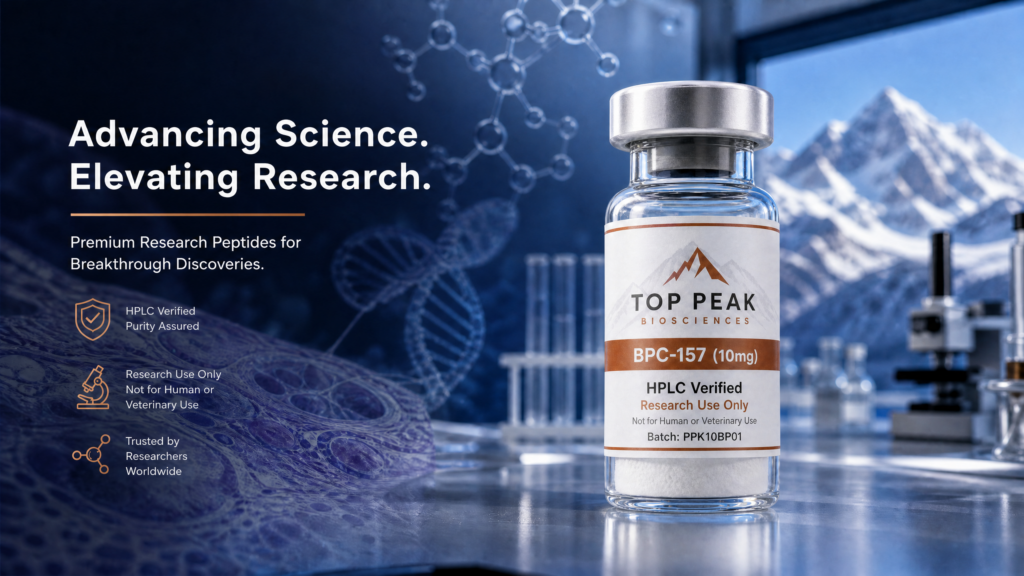
At TOP PEAK BIOSCIENCES, we provide HPLC-verified BPC-157 at 99%+ purity to support the global research community in advancing our understanding of this remarkable peptide.
Molecular Profile
| Property | Detail |
| Sequence | Gly-Glu-Pro-Pro-Pro-Gly-Lys-Pro-Ala-Asp-Asp-Ala-Gly-Leu-Val |
| Molecular Formula | C₆₂H₉₈N₁₆O₂₂ |
| Molecular Weight | 1419.53 g/mol |
| CAS Number | 137525-51-0 |
| Purity (HPLC) | ≥99% |
| Appearance | White lyophilized powder |
| Storage | -20°C, protected from light |
Key Research Areas
1. Tissue Repair and Wound Healing
Multiple preclinical studies have demonstrated BPC-157’s potential role in accelerating tissue repair processes. Research published in the Journal of Physiology has shown that BPC-157 may promote angiogenesis — the formation of new blood vessels — which is critical for delivering nutrients and oxygen to damaged tissues.
In animal models, BPC-157 has been observed to:
•Accelerate the healing of skin wounds, muscle tears, and tendon injuries
•Promote collagen deposition at wound sites
•Enhance granulation tissue formation
•Support re-epithelialization processes
2. Gastrointestinal Protection
As a compound originally isolated from gastric juice proteins, BPC-157 has been extensively studied for its gastroprotective properties. Research indicates potential applications in:
•Protection against NSAID-induced gastric lesions
•Support of intestinal mucosal integrity
•Modulation of inflammatory bowel conditions in animal models
•Promotion of gastric ulcer healing
3. Musculoskeletal Research
One of the most active areas of BPC-157 research involves its effects on musculoskeletal tissues. Studies have examined its influence on:
•Tendon-to-bone healing in rotator cuff injury models
•Achilles tendon repair acceleration
•Muscle healing following crush injuries
•Bone fracture repair processes
4. Neuroprotective Mechanisms
Emerging research suggests BPC-157 may interact with multiple neurotransmitter systems, including dopaminergic, serotonergic, and GABAergic pathways. Studies have investigated:
•Protection against peripheral nerve damage
•Potential modulation of NO (nitric oxide) system
•Interaction with growth factor signaling (VEGF, EGF)
Mechanism of Action
While the precise mechanism of action remains under investigation, current research suggests BPC-157 operates through several interconnected pathways:
1.VEGF Upregulation — Promotes vascular endothelial growth factor expression, supporting new blood vessel formation
2.NO System Modulation — Interacts with the nitric oxide system to influence vasodilation and tissue perfusion
3.Growth Factor Signaling — May enhance EGF receptor expression and downstream signaling cascades
4.FAK-Paxillin Pathway — Research indicates involvement in focal adhesion kinase signaling, critical for cell migration and tissue organization
Research Considerations
Reconstitution Protocol
For research purposes, BPC-157 lyophilized powder should be reconstituted with bacteriostatic water (0.9% benzyl alcohol). Standard reconstitution volumes range from 1-2mL per vial depending on desired concentration.
Storage Guidelines
•Lyophilized (unreconstituted): Store at -20°C for long-term stability (up to 24 months)
•Reconstituted: Store at 2-8°C and use within 30 days
•Avoid: Repeated freeze-thaw cycles, direct sunlight, temperatures above 25°C
Quality Assurance at TOP PEAK BIOSCIENCES
Every batch of BPC-157 from TOP PEAK BIOSCIENCES undergoes rigorous quality control:
•HPLC Analysis — Confirms ≥99% purity
•Mass Spectrometry — Verifies correct molecular weight and sequence
•Endotoxin Testing — Ensures research-grade sterility standards
•Certificate of Analysis — Provided with every order, including batch-specific data
Conclusion
BPC-157 continues to be one of the most promising peptides in regenerative research. Its multi-system activity, favorable stability profile, and extensive preclinical literature make it an essential compound for researchers investigating tissue repair, cytoprotection, and growth factor signaling pathways.
TOP PEAK BIOSCIENCES is committed to providing the highest quality BPC-157 for research use, backed by third-party HPLC verification and comprehensive Certificates of Analysis.
This article is for informational and educational purposes only. All products are sold strictly for research use. Not for human or veterinary use.
References available upon request. Contact support@toppeakbio.com